

Engineering Biocatalysts for a Sustainable Future
In the pursuit of a greener planet, the PROPA Lab utilizing the power of nature’s most efficient catalysts: enzymes. Our Enzyme Engineering division is dedicated to redesigning and optimizing enzymes for demanding industrial applications, replacing harsh chemical processes with efficient, ecofriendly biocatalytic solutions.
Bioconversion of Glycerol to industrial product
Our research in enzyme engineering focuses on the structure-guided and rational modification of enzymes to improve stability, catalytic efficiency, and robustness for biomedical and biotechnological applications. We have engineered coenzyme B12-dependent glycerol dehydratase by reinforcing the α–β subunit interface, achieving up to 24-fold enhanced resistance to inactivation while maintaining catalytic performance and significantly reducing coenzyme B12 requirements. This improvement not only advances the enzyme’s efficiency but also contributes to more sustainable bioprocesses for industrial applications.

Fig: Glycerol Dehydratase Engineering Strategy
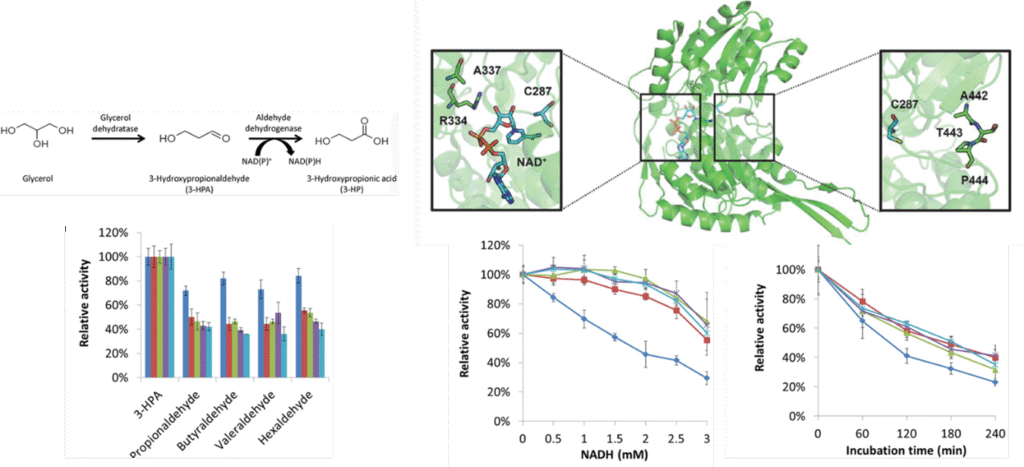
In parallel, we have engineered α-ketoglutaric semialdehyde dehydrogenase (KGSADH) through substrate- and cofactor-binding pocket optimization, resulting in variants with lower Km values, higher catalytic efficiency, and improved tolerance to toxic intermediates, enabling increased 3-hydroxypropionic acid production in microbial systems.
In addition, we apply computational modeling and structure-based mutagenesis to engineer prokaryotic Argonaute nucleases, where targeted mutations significantly enhanced DNA cleavage activity at physiological temperatures, expanding their potential for programmable nucleic-acid applications further advancing biotechnology’s ability to develop sustainable genetic engineering solutions.